
What You Get in 30-45 Days with an MVP Studio (Deliverables Checklist 2026)
What does €8k-€18k get you in 30-45 days? See exact deliverables: architecture, working MVP, hardening, and knowledge transfer. Read the full guide.
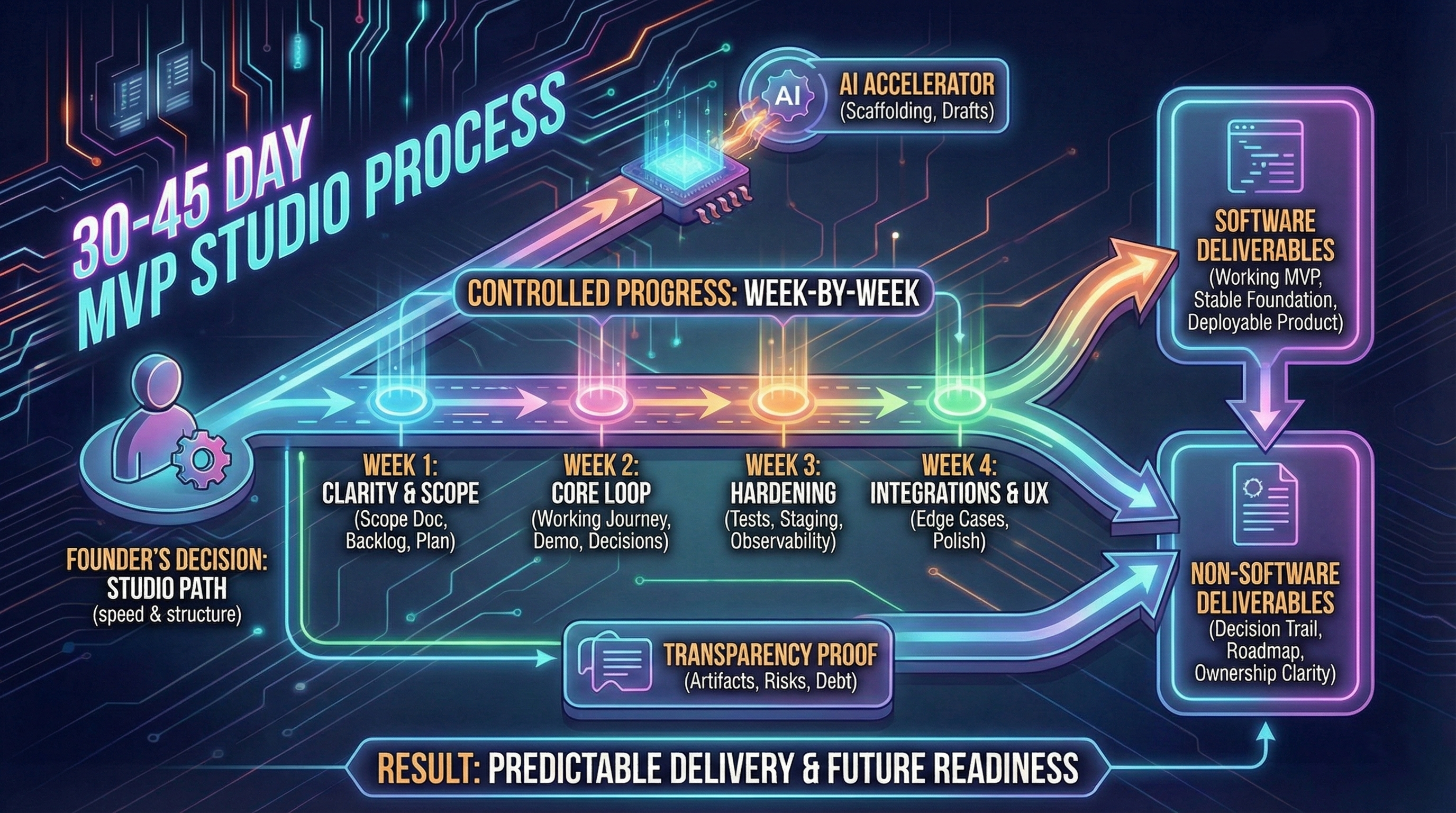
When founders ask, “What do I get for €8k-€18k in 30-45 days?”, the answer is not just “code.”
You get:
- Architecture decisions (explicit, documented)
- A working MVP (not a prototype)
- Hardening (tests, staging, monitoring)
- Knowledge transfer (you own it)
This article breaks down exactly what happens week-by-week.
If you’re looking for an MVP studio, talk to our team about what we deliver in 30-45 days.
For pricing context:
Week 1: Architecture & Planning (Not “Just Start Coding”)
Why this matters: Skipping architecture = technical debt from Day 1.
Deliverables:
- Data model design (tables, relationships, constraints)
- API contract definition (endpoints, request/response shapes)
- Tech stack selection (Next.js vs Django, reasoning documented)
- Deployment strategy (Vercel, Railway, AWS)
- Scope document (what’s in MVP, what’s Phase 2)
Time: 1 week (20-30% of total timeline).
Output: Architecture doc (5-10 pages) + schema diagram + API blueprint.
Example: B2B SaaS dashboard. Week 1 output:
- Schema: Users (id, email, role), Projects (id, name, owner_id), Tasks (id, title, project_id, assignee_id)
- API:
POST /auth/login,GET /projects,POST /tasks - Stack: Next.js + Supabase + Vercel
- Scope: MVP = 1 user role, 3 core features. Phase 2 = multi-tenant, advanced permissions.
Stack selection follows the principles in our MVP tech stack guide—optimized for shipping speed while keeping iteration cost low.
Week 2-4: Core MVP Build (Working Product, Not Demo)
What gets built:
Week 2: Foundation
- Auth (login, signup, password reset)
- User session handling (JWT, refresh tokens)
- Basic UI (landing page, dashboard shell)
- Database setup (migrations, seed data)
Week 3: Core Feature
- Main value-driving feature (e.g., task board, payment flow, search)
- Business logic (centralized rules, not scattered in UI)
- Basic error handling (try-catch, user-friendly messages)
Week 4: Secondary Features
- Admin panel (user management, basic reporting)
- Integrations (Stripe, email, analytics)
- Responsive UI (mobile-friendly)
Time: 3 weeks (60-70% of timeline).
Output: Functional MVP on staging environment.
Week 5-6: Hardening (Why Your MVP Won’t Break)
What hardening includes:
- Automated tests (core flows: signup, payment, key feature)
- Staging environment (deploy preview, test before prod)
- Error tracking (Sentry integration, Slack alerts)
- Logging (structured logs, request IDs for debugging)
- Database backups (automated daily, tested restore)
- Performance optimization (lazy loading, caching, query optimization)
Time: 1-2 weeks (15-20% of timeline).
Why this matters: Without hardening, every change is risky.
Related Insights
Post-Launch: What Happens After Week 6?
Week 7-8 (included in package):
- Bug fixes (critical issues only, not new features)
- Deployment support (help with DNS, SSL, production setup)
- Monitoring setup (Vercel Analytics, PostHog, or Plausible)
- Handoff session (2-hour walkthrough: code structure, deployment, how to add features)
Beyond Week 8 (optional retainer):
- Maintenance: €500-€1.5k/month (bug fixes, minor updates, monitoring)
- Feature development: €3k-€8k per feature (depends on complexity)
Deliverables Checklist (What You Own)
Code & Infrastructure
- Source code (GitHub repo, you own it)
- Deployment pipeline (CI/CD setup, one-click deploy)
- Staging environment (separate from production)
- Database backups (automated, tested restore)
Documentation
- Architecture doc (why decisions were made)
- API documentation (endpoints, request/response examples)
- README (how to run locally, deploy, add features)
- Data model diagram (schema, relationships)
Monitoring & Observability
- Error tracking (Sentry configured, alerts setup)
- Analytics (PostHog, Plausible, or Vercel Analytics)
- Logging (structured logs, query-able)
Knowledge Transfer
- Handoff session (2 hours: code walkthrough, Q&A)
- Video recordings (deploy process, common tasks)
- Support channel (Slack/Discord for 2 weeks post-launch)
What You DON’T Get (Setting Expectations)
Not included:
- Unlimited revisions (scope changes cost extra)
- Marketing/sales (MVPs don’t sell themselves)
- 24/7 support (business hours support only)
- Lifetime maintenance (post-launch support = 2 weeks, then optional retainer)
- Perfection (MVPs have acceptable debt, documented)
Why this matters: Clear expectations = no surprises.
Cost Breakdown: Where Your Money Goes
€15k MVP example (6 weeks):
- Week 1 (Architecture): €2.5k (20h @ €125/h)
- Week 2-4 (Build): €9k (72h @ €125/h)
- Week 5-6 (Hardening): €2.5k (20h @ €125/h)
- Post-launch (2 weeks): €1k (8h support)
Total: €15k = 120 hours development + 8h support.
Breakdown by activity:
- Planning/architecture: 20%
- Core development: 60%
- Hardening: 15%
- Support: 5%
For the full tier breakdown (Founder / Scale / Enterprise), see MVP pricing and packaging.
DIY vs Studio: Time Comparison
| Activity | DIY (Solo Founder) | Studio (Partner) |
|---|---|---|
| Architecture | 2-4 weeks (trial/error) | 1 week (experience) |
| Core build | 6-12 weeks (learning) | 3 weeks (focused) |
| Hardening | 2-4 weeks (if done at all) | 1-2 weeks (standard) |
| Total | 10-20 weeks | 5-6 weeks |
Time saved: 5-14 weeks (founder can focus on sales/validation). If you’re weighing these trade-offs, the DIY vs partner scorecard helps you decide in 15 minutes.
How We Work at The Byte-sized
Week 1: Kickoff call (2h) → Architecture draft (3 days) → Review session (1h) → Finalize.
Week 2-6: Weekly demos (Friday 1h) → Show progress → Get feedback → Adjust scope if needed.
Week 7-8: Handoff session (2h) → Support channel (Slack 2 weeks) → Optional retainer.
Transparency: You see code daily (GitHub access), weekly demos (not black box). Our full approach to operational transparency in AI-assisted development explains what this looks like in practice.
Conclusion: You’re Buying Speed + Certainty, Not Just Code
In 30-45 days, you get:
- Working MVP (production-ready, not prototype)
- Architecture (decisions documented, technical debt controlled)
- Hardening (tests, staging, monitoring)
- Ownership (code, docs, knowledge transfer)
What you DON’T get: unlimited revisions, lifetime support, marketing magic.
Remember: €8k-€18k buys 5-6 weeks focused development + 2 weeks support. DIY takes 10-20 weeks (5-14 weeks slower).