
How to Scope an MVP Without Bloat (Must-Have Filter + Budget Guide 2026)
The biggest MVP mistake? Building too much. Get a 5-question filter, realistic budgets, and a timeboxing framework to ship in 4-8 weeks. Contact us to learn more.
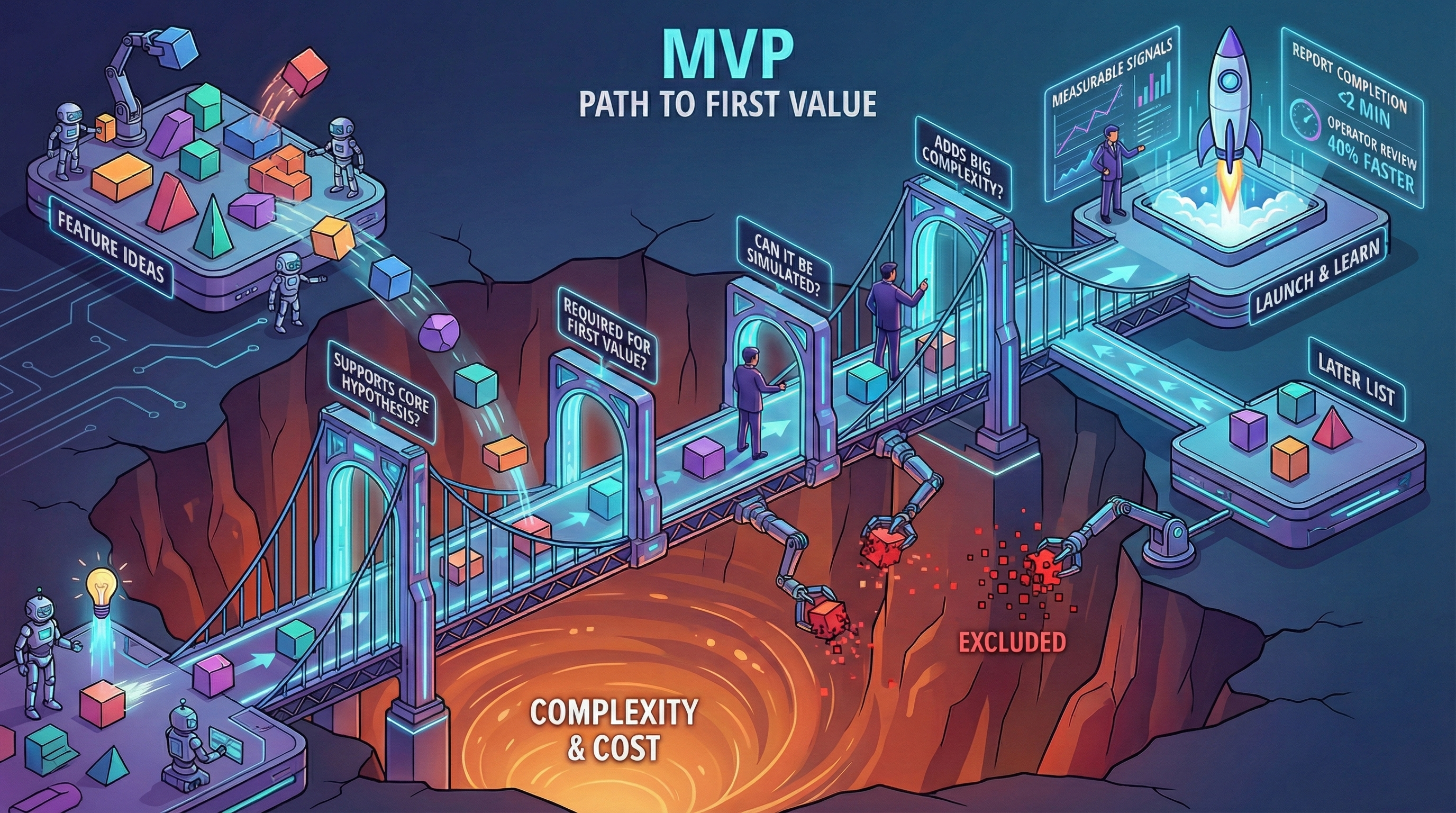
The biggest MVP mistake isn’t building the wrong thing. It’s building too much of the right thing.
After building 50+ MVPs for founders across Europe, we’ve learned one thing: scope creep is the silent killer of startup momentum. Most founders confuse “minimum” with “incomplete.” They add “just one more feature”—then another—until the MVP takes 6 months instead of 6 weeks and costs €35k instead of €12k.
This article shows you how to scope an MVP that validates your riskiest assumption in 4-8 weeks, with clear budget tiers and real examples.
Ready to scope your MVP? Talk to our team for a free scoping session.
For context on choosing between MVP, prototype, or PoC first, see MVP vs Prototype vs PoC.
The Must-Have vs Nice-to-Have filter
Every feature falls into one of three categories:
- Must-Have: Without this, the MVP doesn’t work at all (validates nothing).
- Nice-to-Have: Makes the experience better but isn’t critical for validation.
- Not-Now: Valuable long-term but doesn’t affect the MVP hypothesis.
The filter is a set of 5 questions. If a feature fails any question, it’s not Must-Have.
The 5 questions
- Does this feature directly test your riskiest assumption?
- Can users complete the core workflow without it?
- Would you rather ship 2 weeks earlier without it?
- Can it wait until v1.1 based on real user feedback?
- Is there a manual workaround (concierge approach)?
If you answer “no” to #1 or “yes” to #2-5, the feature is Nice-to-Have or Not-Now.
For more on validating assumptions early, see our guide on user interviews for MVPs.
Budget breakdown: Founder / Scale / Enterprise
MVP cost varies by complexity, timeline, and team. Here’s a realistic 2026 breakdown for outsourced development in Europe (studio/agency rates).
For detailed pricing including Napoli’s 30-40% cost advantage, see our MVP pricing guide.
Founder MVP: €8k-€12k (4-6 weeks)
What you get:
- Simple CRUD (Create, Read, Update, Delete) operations
- 3-5 core screens (login, dashboard, one main workflow)
- Basic authentication (email/password)
- Single user role (no admin panel)
- Hosted on managed platform (Vercel, Railway, Supabase)
- Basic analytics (PostHog, Plausible)
- Mobile-responsive (web app, not native)
What you skip (Phase 2):
- Payments/billing
- Email notifications
- Multi-user collaboration
- Advanced permissions
- Complex workflows
Example: B2B lead tracker. Users log leads, add notes, mark status. Export to CSV. That’s it.
Best for: Solo founders, first-time builders, technical co-founders validating demand.
Scale MVP: €18k-€25k (8-10 weeks)
What you get (everything in Founder +):
- Payments integration (Stripe, subscriptions)
- Email notifications (transactional)
- 2-3 user roles (admin, member)
- Team collaboration (invite users, shared workspaces)
- API integrations (1-2 third-party services)
- Error tracking + monitoring (Sentry)
- Basic search/filters
What you skip (Phase 2):
- Advanced analytics
- Mobile native app
- Complex automations
- White-label / multi-tenancy
- Advanced API endpoints
Example: B2B SaaS tool. Users create projects, invite teammates, assign tasks, pay monthly subscription, export reports.
Best for: Funded startups, B2B SaaS, products with clear monetization.
For execution planning at this scale, see our MVP project management guide.
Enterprise MVP: €35k-€50k+ (12-16 weeks)
What you get (everything in Scale +):
- Complex workflows (multi-step, conditional logic)
- Advanced permissions (RBAC, SSO)
- Multiple integrations (3-5+ APIs)
- AI/ML features (LLM integration, embeddings, RAG)
- Real-time features (WebSocket, live updates)
- Mobile native app (React Native, Flutter)
- Advanced analytics + dashboards
- White-label / multi-tenancy
- Compliance (GDPR, HIPAA starter)
Example: AI-powered content platform. Users upload documents, AI extracts insights, generates reports, collaborates with team in real-time, white-label for enterprises.
Best for: Series A+ startups, complex B2B products, AI-native tools, regulated industries.
Timeboxing framework: 4-8 weeks
Timeboxing means fixing the timeline, not the scope. Instead of “we’ll launch when it’s ready” (spoiler: never), you commit to a launch date and cut features to fit.
Week-by-week breakdown
For a detailed week-by-week roadmap with effort allocation, see our MVP roadmap: 4-8 weeks.
Week 1: Scope + wireframes + tech decisions
- Output: Final feature list (Must-Haves only), clickable wireframes (Figma), tech stack decided.
Week 2-6: Build + iterate
- Sprint 1 (Week 2-3): Core workflow (users can complete one end-to-end action).
- Sprint 2 (Week 4-5): Secondary features (auth, profiles, basic UI polish).
- Sprint 3 (Week 6): Hardening (error handling, edge cases, mobile responsive).
Week 7: Testing + bug fixing
- Internal QA, fix critical bugs, deploy to staging.
Week 8: Launch prep + soft launch
- Analytics setup, landing page copy, invite 10-20 beta users.
For launch readiness, see our MVP launch checklist.
Common scoping traps
Trap 1: Gold plating (“Let’s make it perfect”)
Symptom: “Before we launch, let’s add dark mode, onboarding tooltips, keyboard shortcuts…”
Why it’s expensive: Each “small polish” adds 3-5 days. 5 polish items = 3 weeks delay.
Fix: Launch with “good enough” UI. Polish based on user feedback (users will tell you what actually matters).
Trap 2: Unclear MVV (Minimum Viable Value)
Symptom: “We need payments, dashboards, and email, but we’re not sure what the core value is.”
Why it’s expensive: Building features without knowing which one validates your hypothesis = waste.
Fix: Define MVV first: “Users will pay if they can X.” Build only X. Measure.
Trap 3: Feature creep (“Just one more thing”)
Symptom: Mid-development, founder says, “Can we add Y? It’s quick!”
Why it’s expensive: “Quick” features break existing code, add testing overhead, delay launch by 1-2 weeks each.
Fix: Freeze scope after Week 1. Write down new ideas for v1.1. Launch first.
Trap 4: Skipping technical trade-offs
Symptom: “Let’s use the latest framework / build custom CMS / write our own auth.”
Why it’s expensive: Custom = 2-4x longer than off-the-shelf. Delays MVP by 4-8 weeks.
Fix: Use boring, proven tools for MVP. Rebuild custom in Phase 2 if validated.
For avoiding technical pitfalls, see our guide on signs of technical debt and why every fix breaks something else.
Real examples: B2B SaaS scoping
Example 1: Lead scoring tool
Hypothesis: Sales teams will pay for automated lead scoring.
Riskiest assumption: Lead scoring algorithm accuracy (users trust it enough to act on scores).
Must-Haves:
- CSV upload (import leads)
- Scoring algorithm (show score 0-100)
- Lead list view (sort by score)
- Export scored leads (CSV)
Nice-to-Haves (Phase 2):
- CRM integration (Salesforce, HubSpot)
- Custom scoring rules
- Email notifications
- Team collaboration
Scope: 4 weeks, €8k-€10k.
Result: Launched with Must-Haves only. 30% of users upgraded to paid after 2 weeks. Validated. Added CRM integration in Phase 2.
Example 2: Marketplace for freelance designers
Hypothesis: Agencies will pay for vetted designer freelancers.
Riskiest assumption: Supply (designers will sign up) + demand (agencies will browse).
Must-Haves:
- Designer profiles (portfolio, hourly rate)
- Agency browse/search (filter by skill, rate)
- Contact designer (send message)
- Basic payment escrow (Stripe Connect)
Nice-to-Haves (Phase 2):
- Designer vetting process (manual for MVP)
- Reviews/ratings
- Project management tools
- Invoicing
Scope: 8 weeks, €18k-€22k.
Result: Launched with 20 designers (manually recruited). 10 agencies signed up Week 1. Validated demand. Added vetting process in Phase 2.
For go-to-market strategies to get your first users, see MVP go-to-market: first 100 users.
How to apply this to your MVP
Step 1: Write down your hypothesis
“[User type] will [action] if they can [outcome].”
Example: “B2B sales teams will pay $99/month if they can score leads automatically and save 10 hours/week.”
Step 2: Identify your riskiest assumption
What’s the ONE thing that, if wrong, kills the product?
- Demand risk: Will users actually pay? (Test with concierge MVP first)
- Feasibility risk: Can we build this? (Test with PoC first)
- UX risk: Will users understand this? (Test with prototype first)
For choosing the right validation approach, see MVP vs Prototype vs PoC.
Step 3: List features, run Must-Have filter
For each feature, ask the 5 questions. If it doesn’t pass, it’s not Must-Have.
Step 4: Budget and timebox
Pick a tier (Founder / Scale / Enterprise), commit to timeline (4-8 weeks), cut features to fit.
If you’re unsure whether to build yourself or partner with a studio, use our DIY vs partner scorecard.
Step 5: Freeze scope, ship, measure
No changes after Week 1. Ship on schedule. Measure MVP success metrics. Iterate based on data.
For strategic decisions after launch, see From MVP to product: key decisions.
Conclusion: Minimum means minimum
Most MVPs fail not because founders build the wrong thing, but because they build too much of the right thing.
Remember:
- Must-Have filter: 5 questions. If a feature fails any, cut it.
- Budget tiers: Founder €8k-€12k (4-6w), Scale €18k-€25k (8-10w), Enterprise €35k-€50k+ (12-16w).
- Timeboxing: Fix timeline (4-8w), cut scope to fit. Launch on schedule.
- Common traps: Gold plating, unclear MVV, feature creep, custom tech.
- Real examples: Lead scoring (4w, €8k), marketplace (8w, €18k) - Creative Two-Sided Marketplace Platform.
Ship minimum. Measure. Iterate.
Sources
- Harvard Business Review: The Lean Startup - Validating assumptions through minimum viable products
- Stanford Research on Startup Validation - Evidence-based approaches to MVP development