
MVP Project Management: Sprints, Tools, and Anti-Scope Creep (2026 Guide)
MVPs fail from delivery losing focus, not bad code. Get lightweight sprint rhythms, backlog structures, and scope-control that keeps teams moving. Contact us to learn more.
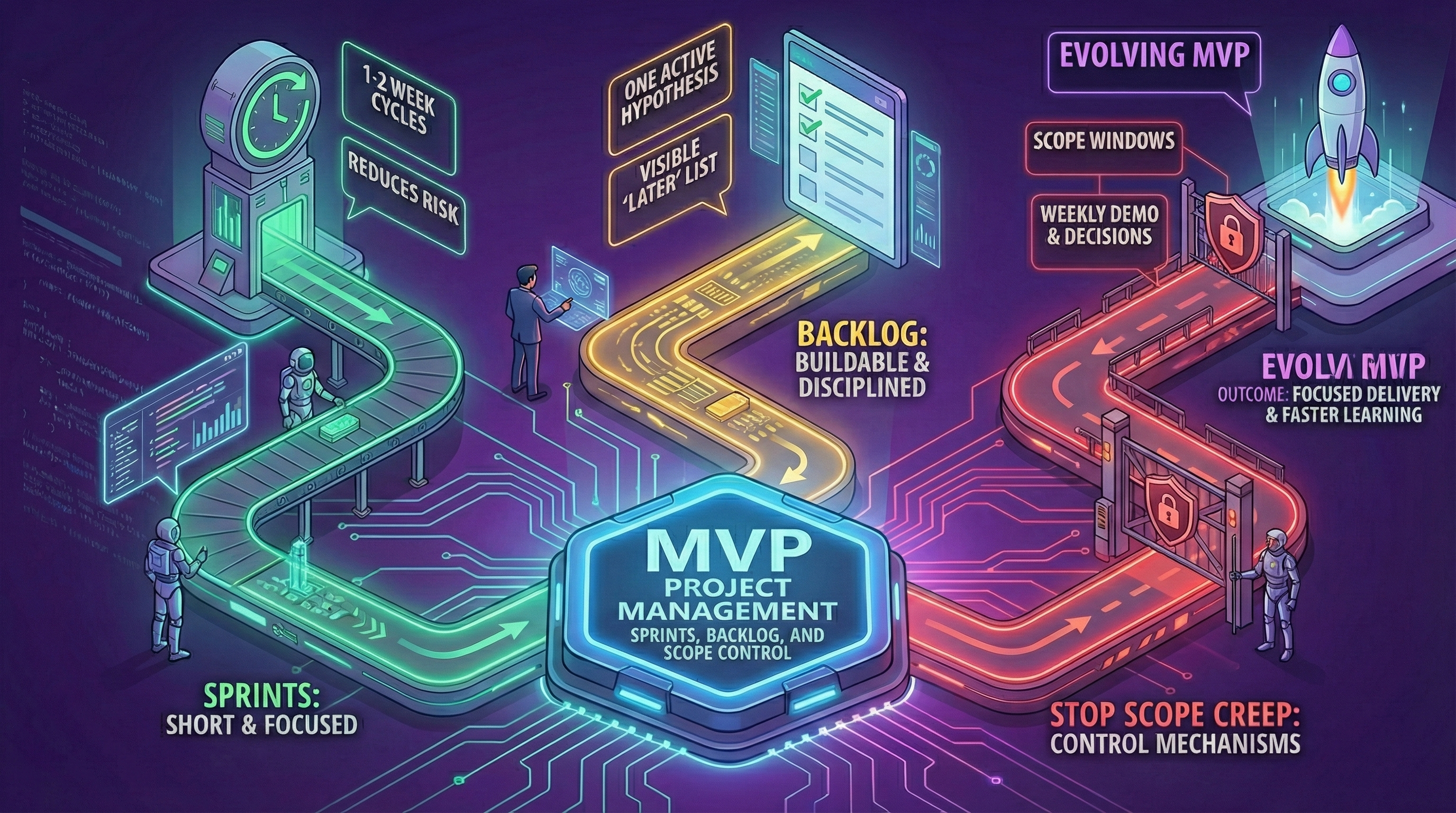
Most MVPs don’t fail because of bad code. They fail because delivery loses focus.
Need help managing your MVP project? Talk to our consultants for project management support.
Backlogs grow, priorities shift, and what started as a lean experiment turns into an unfocused build. The fix isn’t more process—it’s the right rhythm.
This article shows a lightweight approach designed for MVPs, aligned with the 4-8 week roadmap.
Why MVP delivery is different
Traditional project management optimizes for predictability. MVP delivery optimizes for learning speed (see metrics).
Traditional PM:
- Fixed scope, flexible timeline
- Gantt charts, milestones
- Minimize rework
MVP PM:
- Fixed timeline (4-8 weeks), flexible scope
- Sprint-based, weekly demos
- Embrace iteration (rework = learning)
Goal shift: Ship fast, measure, decide (not ship perfect).
Tools by team size
Choose tools based on team composition, not feature lists.
Solo founder (technical)
Tool: Notion or GitHub Projects
Why: Simple, no overhead, markdown-friendly.
Setup:
- Board view: To Do / In Progress / Done
- 3 columns max (avoid overcomplication)
- Link to GitHub issues (if using GitHub)
Cost: Free (Notion), Free (GitHub Projects).
Small team (2-4 people)
Tool: Linear or Notion
Why: Clean UI, fast shortcuts, good for async work.
Setup:
- Projects = MVP phases (Onboarding, Core Feature, Launch)
- Cycles = 1-week or 2-week sprints
- Priorities: P0 (must-have), P1 (should-have), P2 (nice-to-have)
Cost: Linear free tier (unlimited issues, 250 users max), Notion €8/user/month.
Outsourced team / Agency
Tool: Jira or ClickUp
Why: Agencies often use these, integration with their workflows.
Setup:
- Epic = MVP scope
- Sprints = 1-2 weeks
- Daily standups (async via Slack or Loom)
Cost: Jira €7/user/month, ClickUp free tier (unlimited tasks).
Avoid over-tooling
Red flags:
- Multiple tools (Jira + Asana + Trello = chaos)
- Custom workflows before Week 1 (premature process)
- Time tracking at MVP stage (optimize for speed, not billable hours)
Rule: Pick one tool, keep it simple, iterate setup as team grows.
Sprint length
For most MVPs: 1-week or 2-week sprints.
1-week sprints (best for):
- Solo founder or 2-person team
- High uncertainty (lots of unknowns)
- Rapid iteration needed
2-week sprints (best for):
- 3-5 person team
- Medium uncertainty
- Balance between planning overhead and flexibility
Avoid 3+ week sprints: Too long for MVP stage (priorities shift fast, 3 weeks = stale plan).
Short sprints force prioritization and reduce risk.
Weekly cadence template
Monday: Sprint Planning (1 hour)
Participants: Full team (founders, devs, designer if applicable).
Agenda:
- Review last sprint (what shipped, what didn’t)
- Demo last sprint outcomes (functional demo, not slides)
- Pick this week’s goal (1 sentence: “Enable user activation flow”)
- Break goal into tasks (3-7 tasks max)
- Assign owners
Output: Sprint backlog locked (no changes mid-sprint unless blocker).
Wednesday: Mid-Sprint Check-In (30 min, optional)
When to use: If team >3 people or blockers frequent.
Agenda:
- Blockers? (technical, design, product decisions)
- On track for Friday demo? (yes/no/at-risk)
- Escalate blockers immediately (don’t wait until Friday)
Async alternative: Slack thread “Wednesday check-in” with 3 questions:
- Progress since Monday?
- Blockers?
- On track for demo?
Friday: Demo + Retrospective (1 hour)
Agenda Part 1: Demo (30 min):
- Show what shipped (functional demo, live environment)
- Metrics snapshot (activation rate, usage, errors)
- Decision: iterate, adjust, or move to next feature
Agenda Part 2: Retrospective (30 min):
- What went well? (celebrate wins)
- What slowed us down? (identify friction)
- One thing to improve next sprint (not 5 things, just 1)
Output: Next sprint’s top priority identified (feeds into Monday planning).
Daily async updates (5 min per person)
Format (Slack, Notion, Linear comment):
Yesterday: Finished signup flow frontend
Today: Connect to backend API
Blockers: NoneAvoid: Daily standup meetings for teams <5 (async is faster).
A buildable backlog
The backlog supports one active hypothesis (see scope).
Structure:
- Now (current sprint, locked)
- Next (next 1-2 sprints, flexible)
- Later (nice-to-haves, post-MVP)
Example backlog (6-week MVP, Week 3):
Now (Week 3 sprint):
- User can upload CSV (core action)
- Display uploaded data in table
- Track “CSV uploaded” event (analytics)
Next (Week 4-5):
- User can filter table
- Export filtered results
- Email summary to user
Later (post-MVP v1.1):
- CRM integrations (Salesforce, HubSpot)
- Advanced filtering (regex, multi-column)
- Scheduled exports
Anything in “Later” is visible but not planned. This prevents “forgotten” feature requests from becoming surprise scope creep.
MVP Definition of Done
A backlog item is done when:
- The user can complete the flow (no broken states, no placeholder “Coming Soon”)
- The outcome is visible (result shown, data saved, email sent)
- It’s measurable (events tracked in analytics)
- The team can observe behavior (can see in dashboard or logs)
Not done:
- “Code written but not deployed”
- “Works on localhost but not production”
- “Feature built but no analytics”
Rule: If it’s not in production with measurement, it’s not done.
Scope-control mechanisms
1. Scope windows (lock within a sprint)
Rule: Once sprint starts Monday, backlog is locked until Friday.
Exception: Critical blocker (production down, security issue).
How to handle mid-sprint requests:
- “Great idea! Adding to Next sprint for evaluation.”
- Don’t say “no” (demotivating), say “not this week” (defers decision).
2. One active hypothesis
Hypothesis format: “If we build X, users will Y, measured by Z.”
Example:
- “If we build CSV upload, users will activate, measured by 50% activation rate.”
Enforce: Every feature must link to hypothesis. If it doesn’t, it’s in “Later.”
3. Weekly demo with decisions
Every Friday demo must end with explicit decision:
- Ship it (deploy to users)
- Iterate (refine this sprint, delay other features)
- Cut it (not working, move to Later)
Avoid: “Let’s see what users think” without measurement plan.
4. Visible “Later” list
Keep a public “Later” list (Notion page, Linear project, GitHub label).
Why: Stakeholders/co-founders see their ideas aren’t forgotten, just deferred.
Review cadence: Monthly (not weekly). Ask: “Do any Later items now belong in Next?”
Blocker management
Blockers kill MVP momentum. Unblock fast or escalate.
Common blockers
Technical blocker (“API integration not working”):
- Timebox fix attempt (4 hours max)
- If still blocked, escalate to Friday demo (decide: fix, workaround, or cut feature)
Design blocker (“Unclear how this flow should work”):
- Quick sketch (30 min)
- User test with 2 people (validate, don’t polish)
- Proceed with validated sketch (iterate later if needed)
Product decision blocker (“Should we build A or B?”):
- Default to simpler option (A vs B → pick faster one)
- Ship A in Week 1, consider B for Next sprint if A works
Escalation path:
- Individual tries to unblock (2-4 hours max)
- Escalate to team lead/founder (same day)
- Decide: fix, workaround, or cut (don’t let blockers linger 3+ days)
Communication framework
Solo founder
- Weekly self-retro (write down: wins, blockers, next priority)
- Accountability partner (another founder, weekly 15min check-in)
Small team (2-4 people)
- Daily async updates (Slack, 5 min)
- Weekly sync (Monday planning + Friday demo, 2 hours total)
- Bi-weekly stakeholder update (investors, advisors → metrics snapshot + decisions)
Outsourced team
- Daily async updates (mandatory, Slack or Linear comments)
- Weekly sync (Monday planning + Friday demo, 2 hours)
- Weekly written update (what shipped, metrics, blockers, next sprint plan)
Avoid: Daily video calls for remote teams (async is faster, respects timezones).
The delivery loop

Cycle time: 1-2 weeks per loop.
Goal: Tight feedback loop (build → ship → measure → decide in days, not months).
Common project management mistakes
Mistake 1: No clear sprint goal
Symptom: Team building 5 unrelated features in one sprint.
Fix: 1 sprint = 1 goal (e.g., “User activation flow works”).
Mistake 2: Planning sprints 4+ weeks ahead
Symptom: Week 6 plan made in Week 1 (ignores learnings from Week 2-5).
Fix: Plan 1 sprint ahead max. Week 3 sprint planned based on Week 2 outcomes.
Mistake 3: No demo discipline
Symptom: “We’re still working on it” (Week 3, Week 4, Week 5…).
Fix: Demo every Friday. If nothing to demo, sprint failed (diagnose why).
Mistake 4: Treating MVP like product roadmap
Symptom: 12-week detailed roadmap for MVP.
Fix: MVP = 4-8 weeks, flexible scope. After MVP validated, switch to product roadmap.
Conclusion
MVP project management is about clarity: short sprints, disciplined backlog, explicit decisions.
Remember:
- Tools: Solo = Notion/GitHub, Small team = Linear, Outsourced = Jira/ClickUp
- Cadence: Monday planning, Wednesday check-in (optional), Friday demo+retro
- Sprints: 1-2 weeks max (not 3+)
- Backlog: Now / Next / Later (only Now is locked)
- Blockers: Timebox 4h, escalate same day, decide fast
Next: Launch checklist—pre-launch readiness after delivery.